When a listing expires, it is frustrating.
For sellers, it feels personal.
For agents, it feels discouraging.
But expired listings in Colorado Springs are rarely about “bad luck.”
They usually come down to strategy, pricing, preparation, or market mismatch.
If you understand why listings expire, you can avoid becoming one.
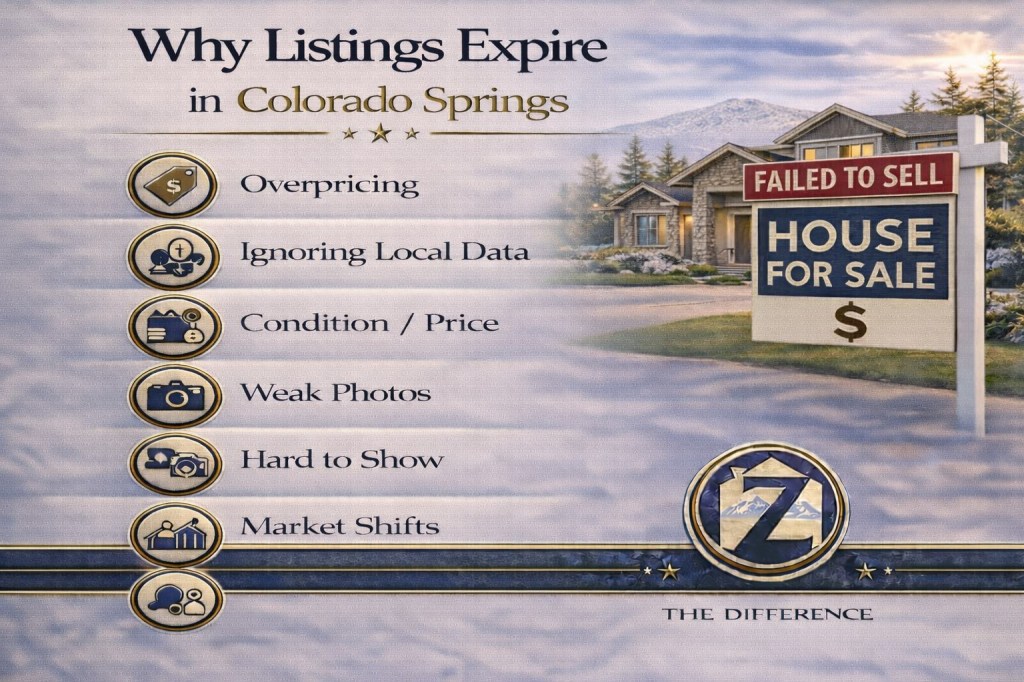
1. Overpricing From Day One
This is the most common reason.
When a home is priced above what buyers in that specific neighborhood are willing to pay, traffic slows immediately.
In Colorado Springs, buyers are watching:
- Recent comparable sales
- Active competition
- Price reductions
- Days on market
If your home launches too high, it misses the strongest buyer pool in the first two weeks.
And once momentum is lost, it is hard to rebuild.
Price reductions later often feel reactive instead of strategic.
2. Ignoring Hyperlocal Market Behavior
Colorado Springs is not one market.
A home in Briargate behaves differently than one near Fort Carson.
A west side property near Garden of the Gods attracts different buyers than a newer build in Banning Lewis Ranch.
When pricing is based on citywide averages instead of subdivision specific data, the strategy can miss the mark.
Expired listings often reflect a disconnect between neighborhood dynamics and pricing decisions.
3. Condition That Does Not Match the Price
Buyers compare homes quickly.
If a listing is priced similar to updated properties nearby but shows:
- Dated finishes
- Deferred maintenance
- Worn carpet
- Older roof
- Exterior neglect
Buyers factor that into their decision immediately.
Condition and price must align.
If they do not, buyers skip it.
4. Weak Online Presentation
Photos are the first showing.
If listing photos are:
- Dark
- Cluttered
- Poorly framed
- Missing key angles
Buyers may never schedule a showing.
In bright Colorado sun, poor photography stands out even more.
If the online presence does not reflect the home’s value, traffic suffers.
No traffic means no offers.
5. Limited Showing Accessibility
Homes that are difficult to show struggle.
If sellers restrict:
- Showing windows
- Weekend availability
- Same day appointments
Buyers may move on to the next property.
In competitive neighborhoods, convenience matters.
The easier it is to show, the more exposure the home receives.
6. Market Shifts During the Listing Period
Sometimes a home launches in one market and expires in another.
Interest rates shift.
Inventory increases.
Buyer demand softens in certain price bands.
If the pricing strategy is not adjusted when market conditions change, listings can stall.
Flexibility matters.
7. Unrealistic Seller Expectations
Emotions are normal when selling a home.
But expectations must align with data.
Expired listings often happen when sellers:
- Resist market feedback
- Decline price adjustments
- Dismiss buyer concerns
- Ignore showing trends
Feedback is information.
When used strategically, it strengthens positioning.
8. Negotiation Breakdown
In some cases, offers came in — but deals fell apart.
Inspection disagreements.
Concession disputes.
Appraisal gaps.
When negotiation flexibility is limited, homes can fall back on market and struggle to regain momentum.
Each failed contract can impact buyer perception.
The Colorado Springs Reality
Listings expire for patterns, not accidents.
The strongest homes in this market have:
Accurate pricing.
Strong presentation.
Hyperlocal strategy.
Flexible response to market feedback.
Clear communication.
When those pieces align, expiration becomes unlikely.
Final Thoughts
An expired listing does not mean the home is undesirable.
It usually means the strategy needs adjustment.
Price.
Condition.
Marketing.
Accessibility.
Expectations.
When those are recalibrated to match the micro market, homes move.
Colorado Springs rewards strategic positioning.
And positioning is what makes the difference.
#zthedifference
 Colorado Springs Real Estate Blog
Leave a comment